Sunday, July 1, 2007

L'amour Fou


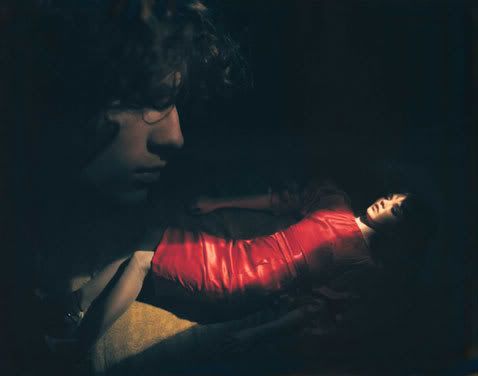
"Fashion was sexy. So was surrealism. They were a natural fit. Nobody ever called cubism sexy, or constructivism, or any of the other movements of the early 20th century except German expressionism, which did have its sexy moments - though not so very many of them. But one of the core beliefs of the surrealists, as set forth by their leader, Andre Breton, was in l'amour fou, obsessional love, the kind of love that deranges the senses and tips those who feel it into a helpless vortex of appetite and feeling..."
L'amour Fou - The Guardian

Fall Picks:


John Rocha's gothic ruffles

The Artful Designer


Carine Roitfeld (in Christopher Kane) with Mario Testino

"Along with "the new black", "the next big thing" is probably the most overused and inaccurate cliche spewed out in the fashion world. This has been particularly true in the British fashion industry, which, desperate to fill an Alexander McQueen-sized hole since he left to hold his shows in Paris almost a decade ago, has parroted the phrase any time a bright young thing with a bit of promise and a lot more confidence has appeared on the ever more depleted London Fashion Week schedule..."
'The Artful Designer' The Guardian

Friday, June 29, 2007

Ian McEwan's 'Atonement' Comes to the Big Screen


On the hottest day of the summer of 1935, thirteen-year-old Briony Tallis sees her older sister Cecilia strip off her clothes and plunge into the fountain in the garden of their country house. Watching Cecilia is their housekeeper's son Robbie Turner, a childhood friend who, along with Briony's sister, has recently graduated from Cambridge. By the end of that day the lives of all three will have been changed forever. Robbie and Cecilia will have crossed a boundary they had never before dared to approach and will have become victims of the younger girl's scheming imagination, and Briony will have committed a dreadful crime, the guilt for which will colour her entire life.

Atonement Trailer

Thursday, June 28, 2007

Fathers and Sons, 1924


Helmut Herzfeld chose to call himself John Heartfield in 1916, as a protest against the anti-British sentiment prevalent in Germany during World War I. Under the influence of Brecht he chose the photomontage as a form of strong political expression. Heartfield activated within the Communist Party of Germany and worked for Die Rothe Fahne and for A-I-Z (Arbeiter Illustrierte Zeitung). After the arrival of Hitler at power, Heartfield left Germany - he moved to Czechoslovakia, then to England. After World War II he settled in East Germany...
John Heartfield' Wikipedia

Hurricane Lolita


(Vladimir Nabоkov, in Ithaca, NY, 1958)

"In Azar Nafisi's Reading Lolita in Tehran, in which young female students meet in secret with Xeroxed copies of Nabokov's masterpiece on their often chaste and recently chadored laps, it is at first a surprise to discover how unscandalized the women are...They "identify" with Lolita, because they can see that she wants above all to be a normal girl-child; they see straight through Humbert, because he is always blaming his victim and claiming that it was she who seduced him. And this perspective—such a bracing change from our conventional worried emphasis on pedophilia—is perhaps more easily come by in a state where virgins are raped before execution because the Koran forbids the execution of virgins; where the censor cuts Ophelia out of the Russian movie version of Hamlet; where any move that a woman makes can be construed as lascivious and inciting; where goatish old men can be gifted with infant brides; and where the age of "consent" is more like nine..."
'Hurricane Lolita' The Atlantic

Monday, June 25, 2007

Off the Beaten Track


"By the end of the 18th century, thanks to scurrilous legends of nymphomaniac nuns and priapic clergy, the medieval history of the whip was established as a stock trope of European pornography: the Marquis de Sade was only the most thorough in this regard. At the same time, the English had managed to acquire a reputation as Europe's most energetic algolagniacs, a celebrity too easily explained by the misty-red memory of public-school thrashings..." 'Off the Beaten Track' New Statesman

Sunday, June 24, 2007

Eloisa to Abelard


How happy is the blameless vestal's lot!
The world forgetting, by the world forgot.
Eternal sunshine of the spotless mind!
Each pray'r accepted, and each wish resign'd;
Labour and rest, that equal periods keep;
"Obedient slumbers that can wake and weep;"
Desires compos'd, affections ever ev'n,
Tears that delight, and sighs that waft to Heav'n.
Grace shines around her with serenest beams,
And whisp'ring angels prompt her golden dreams.
For her th' unfading rose of Eden blooms,
And wings of seraphs shed divine perfumes,
For her the Spouse prepares the bridal ring,
For her white virgins hymeneals sing,
To sounds of heav'nly harps she dies away,
And melts in visions of eternal day.

Far other dreams my erring soul employ,
Far other raptures, of unholy joy:
When at the close of each sad, sorrowing day,
Fancy restores what vengeance snatch'd away,
Then conscience sleeps, and leaving nature free,
All my loose soul unbounded springs to thee.
Oh curs'd, dear horrors of all-conscious night!
How glowing guilt exalts the keen delight!
Provoking Daemons all restraint remove,
And stir within me every source of love.
I hear thee, view thee, gaze o'er all thy charms,
And round thy phantom glue my clasping arms.
I wake--no more I hear, no more I view,
The phantom flies me, as unkind as you.
I call aloud; it hears not what I say;
I stretch my empty arms; it glides away.
To dream once more I close my willing eyes;
Ye soft illusions, dear deceits, arise!
Alas, no more--methinks we wand'ring go
Through dreary wastes, and weep each other's woe,
Where round some mould'ring tower pale ivy creeps,
And low-brow'd rocks hang nodding o'er the deeps.
Sudden you mount, you beckon from the skies;
Clouds interpose, waves roar, and winds arise.
I shriek, start up, the same sad prospect find,
And wake to all the griefs I left behind.

-Alexander Pope
Eloisa to Abelard

Friday, June 22, 2007

What Dad Didn't Tell You About the Birds & the Bees


"For explaining everyday life—babies, puppies, puberty—the mommy-daddy story of procreation works fine. But at life's edges, conventional biology, like conventional physics, breaks down. As you approach the speed of light, time slows and distances shrink. And as you approach extinction, genes find new ways to pass themselves on. Scientists call it "reproductive plasticity." A Komodo dragon manufactures a mate. A shark's got to do what a shark's got to do."...
'Brave Old World' Slate

Tuesday, June 12, 2007

Buffalo buffalo...


"Buffalo buffalo Buffalo buffalo buffalo buffalo Buffalo buffalo" is a grammatically correct sentence used as an example of how homonyms and homophones can be used to create complicated constructs. It has been known to exist since 1972 when the sentence was used by William J. Rapaport, currently an associate professor at the University at Buffalo.[1] It was posted to Linguist List by Rapaport in 1992.[2] It was also featured in Steven Pinker's 1994 book The Language Instinct. Sentences of this type, although not in such a refined form, have been known for a long time. A classic example is the proverb "Don't trouble trouble until trouble troubles you"...

'Buffalo buffalo' Wikipedia.org

Whatever Happened to Weldon Kees?


"It is almost half a century since San Francisco police found a 1954 Plymouth Savoy on the north side of the Golden Gate Bridge. On Tuesday, July 19, 1955, a highway patrol reported that the car, belonging to a Weldon Kees, had been discovered with the keys in the ignition two of Kees’s friends, Michael Grieg and Adria Wilson, went to search the apartment of the missing man. There they found, among other things, his cat, Lonesome, and a pair of red sock in a sink. His wallet, watch, and sleeping bag were missing. So was his savings-account book, although the balance, which stood at more than eight hundred dollars, would remain that way. There was no suicide note"...
'The Disappearing Poet' The New Yorker